








Desert Modernism was launched when Swiss-born architect Albert Frey placed three simple boxes on the desert floor in Palm Springs, California, in 1935. It was Frey's first residential design, utilizing cement floors and corrugated metal to mitigate the intense desert heat. Two years later, Richard Neutra introduced broad overhangs, clean geometry, and seamless indoor-outdoor continuity.
The minimalist style quickly became synonymous with luxury living in arid climates.
Now, a fresh wave of architectural innovation has emerged, building upon the fundamentals of Frey, Neutra, and their contemporaries, but combining them with refined aesthetics and deep sustainability. These new, light-infused designs are rising far from the Coachella Valley — they are reshaping the landscapes of the Middle East.
What began in California as a distinct regional style has become, in the Gulf and the Levant, something closer to an act of cultural reclamation.
The Grammar of Traditional Desert Design
To understand what contemporary Middle Eastern architects are achieving, it helps to understand their structural heritage. The region's building traditions represent millennia of climate intelligence. Visionaries draw inspiration from the desert's sculptural forms and the raw texture of nature, rendering arid landscapes effortlessly livable.
Specific regional elements include the mashrabiya (latticed window screens), elegant arches, soaring domes, and intricate facade patterns. These features are as functional as they are beautiful: structural overhangs deflect the harsh sun to cool indoor spaces, while traditional central courtyards encourage natural ventilation and create inviting communal sanctuaries.
Centuries before mechanical cooling existed, the barjeel, or traditional wind tower, achieved natural air conditioning through differential pressure. These towers capture overhead breezes, channeling the cooler air downward while venting internal heat outward — a process supported by thick mudbrick walls that offer vital thermal mass. These were never mere stylistic choices; they were life-sustaining engineering solutions.
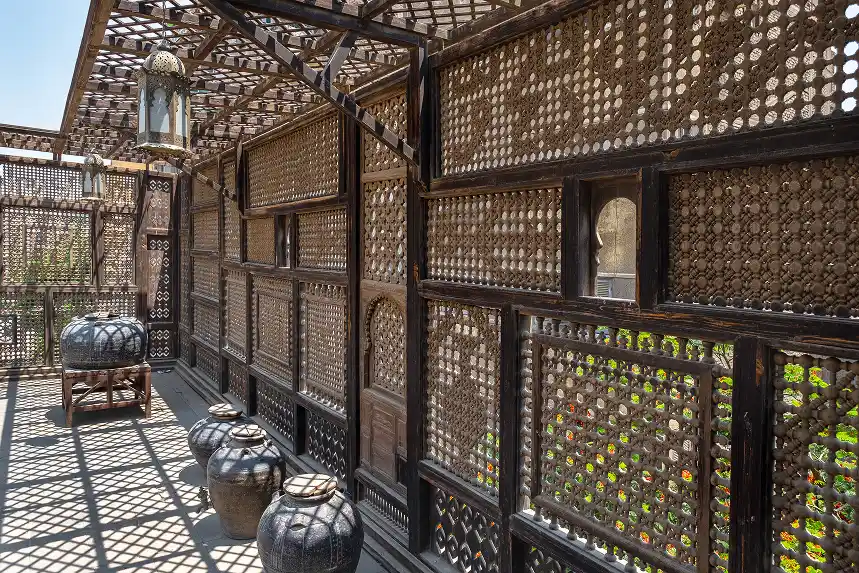
Mashrabiya — Cairo, Egypt. The latticed screen as climate control and cultural expression
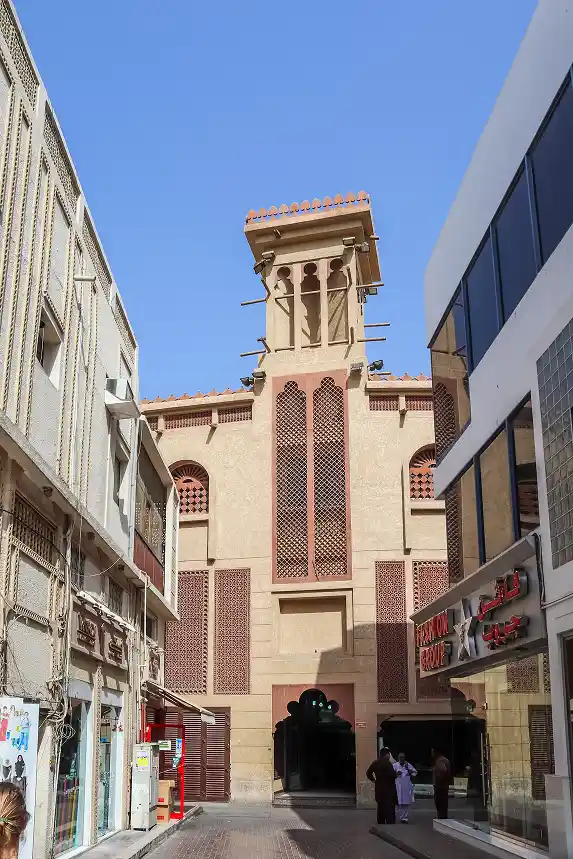
Barjeel — Dubai. The original air conditioning system, refined over centuries
"These were never mere stylistic choices; they were life-sustaining engineering solutions."
Engineering Tradition Into Luxury
Abu Dhabi's Al Bahar Towers, completed in 2012 and designed by the architectural firm Aedas, represent perhaps the most technically rigorous example of modern desert architecture. The towers' exterior features a dynamic skin of over 2,000 geometric panels that act as a cutting-edge solar shield. The automated panels respond fluidly to the sun's movement — closing to block direct glare and gradually opening as the path clears to maximize natural light and views.
Inspired by the traditional mashrabiya, this seemingly decorative facade reduces solar heat gain by half and cuts CO2 emissions by 1,750 tons annually.
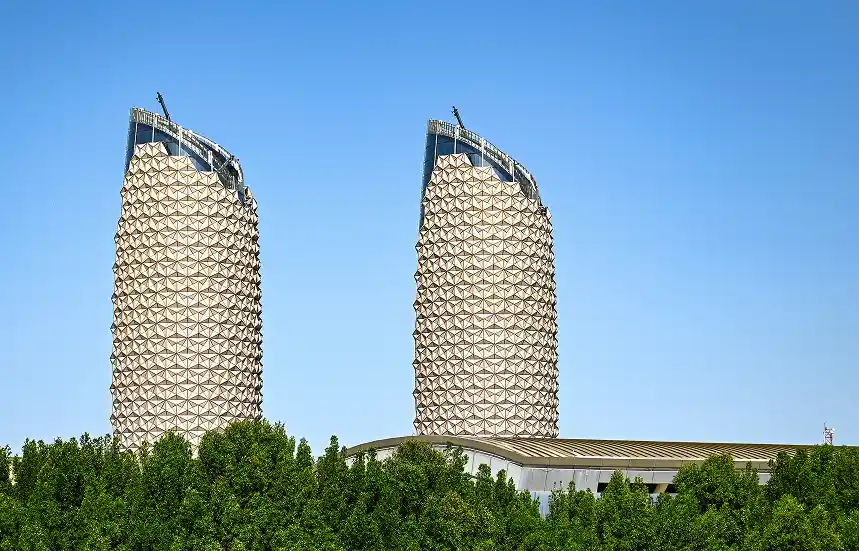
Al Bahar Towers, Abu Dhabi — over 2,000 dynamic mashrabiya panels reduce solar heat gain by 50%
The Al Bahar Towers' dynamic facade reduces solar heat gain by 50% and cuts CO₂ emissions by 1,750 tons annually — one of the most technically rigorous applications of traditional desert design in the modern era.
The Louvre Abu Dhabi
The Louvre Abu Dhabi, designed by Jean Nouvel and opened in 2017, employs a similar philosophy. The museum's spectacular geometric dome draws inspiration from the overlapping fronds of regional palm trees. As sunlight filters through the intricate multilayered lattice, it creates a dappled "rain of light" on the ground below — an effect deeply reminiscent of sunbeams falling through date palms in a desert oasis.
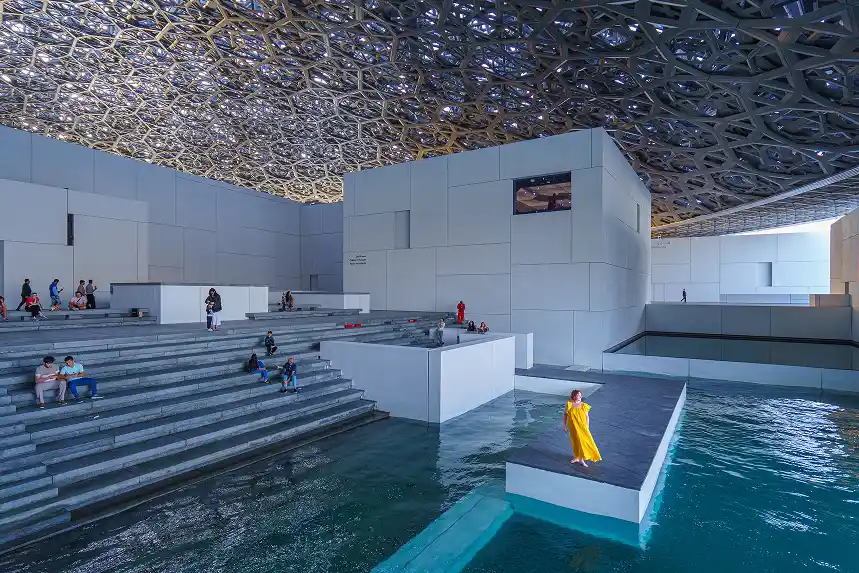
The "rain of light" — sunbeams filtered through Jean Nouvel's geometric lattice dome, Louvre Abu Dhabi
Architect Norman Foster's Masdar City in Abu Dhabi applied this exact methodology at an urban scale. The project, in its initial residential phase, is master-planned to remain 5 to 10 degrees cooler than the surrounding open desert.
Windows and undulating balconies throughout the residential quarters are shielded by another reimagined variation of the mashrabiya. Constructed from sustainably developed, glass-reinforced concrete, the material is tinted with local sand to mirror the natural desert terrain while minimizing long-term maintenance.
Masdar City: The Urban Desert Oasis
The result is a high-tech, serene pedestrian oasis characterized by narrow streets that capture and funnel gentle breezes to create a natural cooling effect. The terracotta-hued walls, deeply recessed windows, and curved screening elements collaborate to create a warm, textured play of light and shadow. A similar aesthetic defines the adjacent Masdar Institute of Science and Technology.
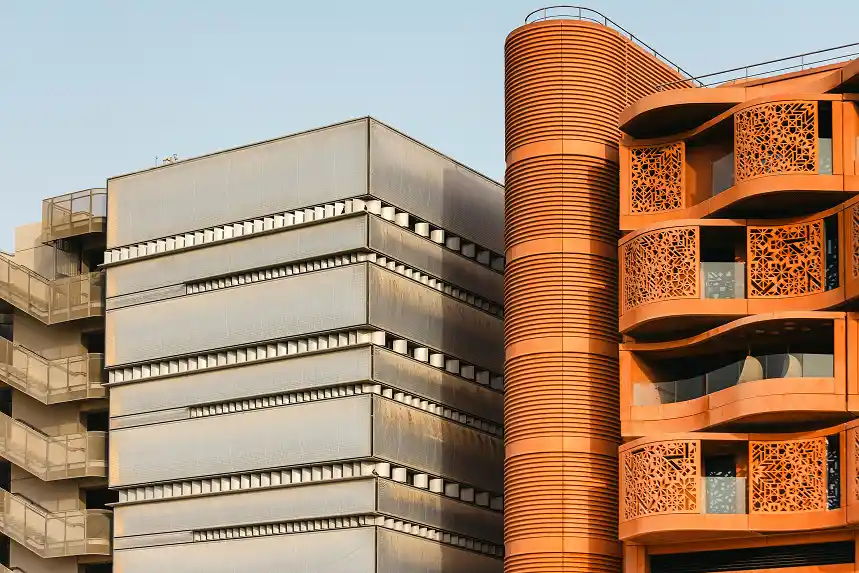
Masdar City, Abu Dhabi — master-planned to remain 5–10°C cooler than the surrounding desert
"What began in California as a distinct regional style has become, in the Gulf and the Levant, something closer to an act of cultural reclamation."
A Development That Echoes Ancient Nabataean Civilizations
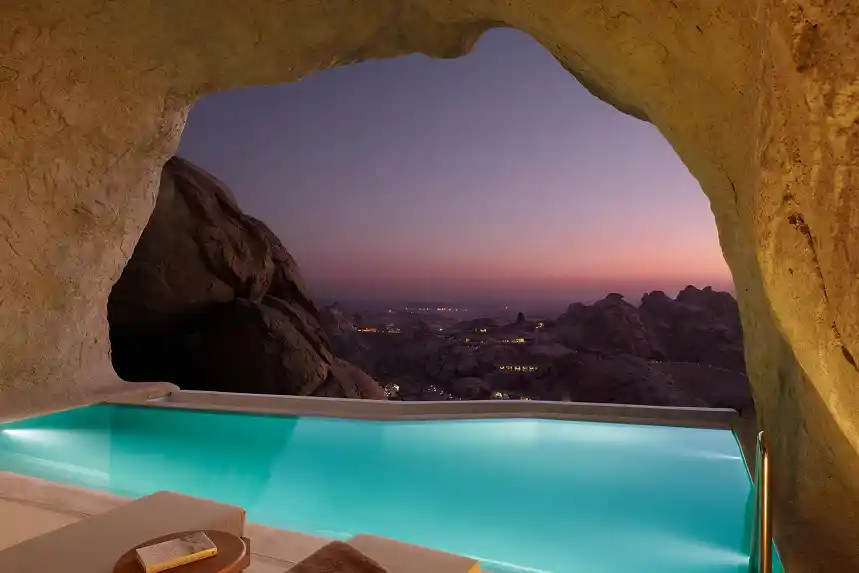
Tucked into the ancient Hejaz Mountains of western Saudi Arabia, Desert Rock seems to disappear entirely within the tectonic landscape. Indoor and outdoor spaces are masterfully secreted within natural caves, rock crevices, and shaded slopes, taking full advantage of cooler microclimates while sheltering guests from direct solar radiation.
During the day, the architecture acts as pure camouflage, blending seamlessly with the ancient sandstone formations. At night, the villas and outdoor pavilions glow softly, resembling lanterns scattered across the valley floor.
The development's silhouette echoes the ancient Nabataean civilizations that once thrived in the region. Those ancestral populations were masters of water management and sustainable desert survival — a legacy that Desert Rock elevates using modern technology.
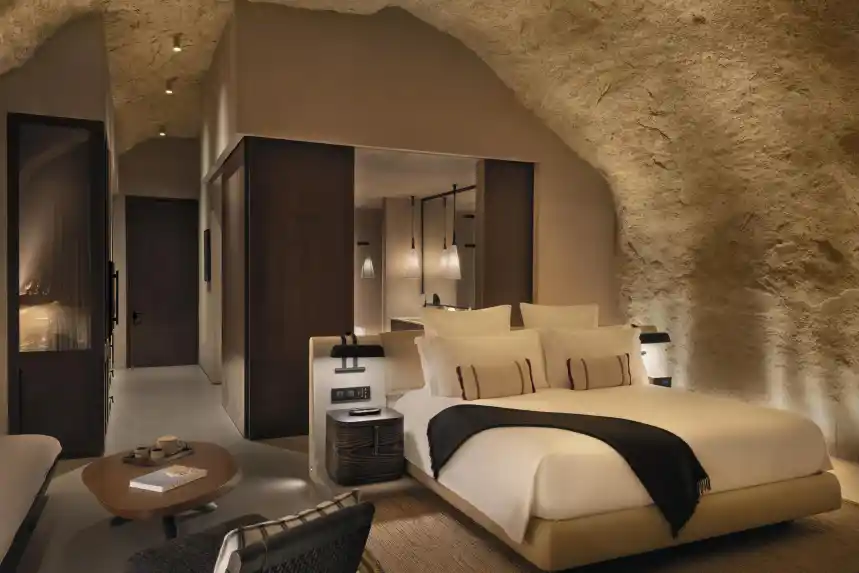
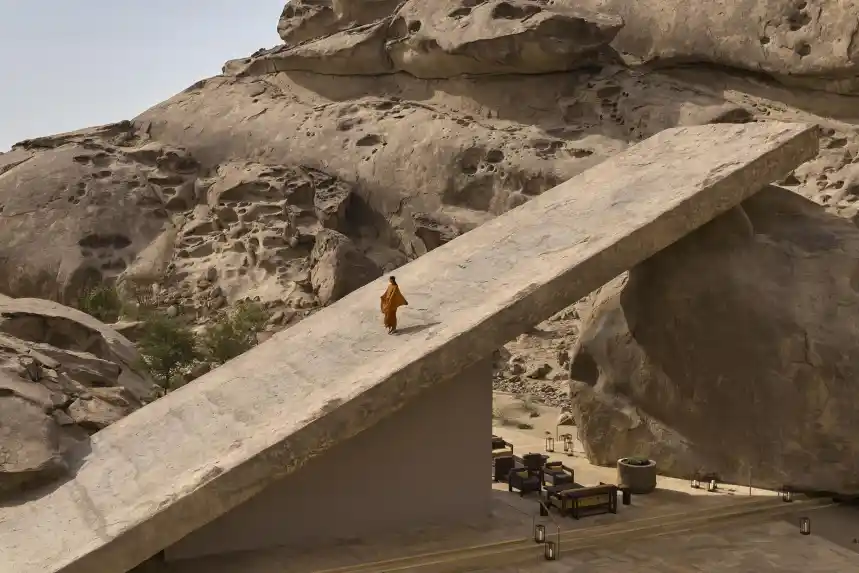
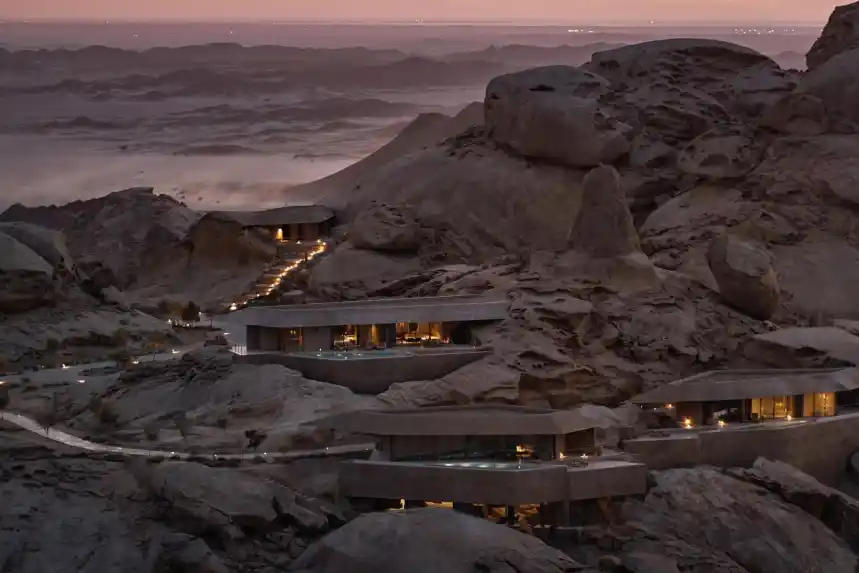
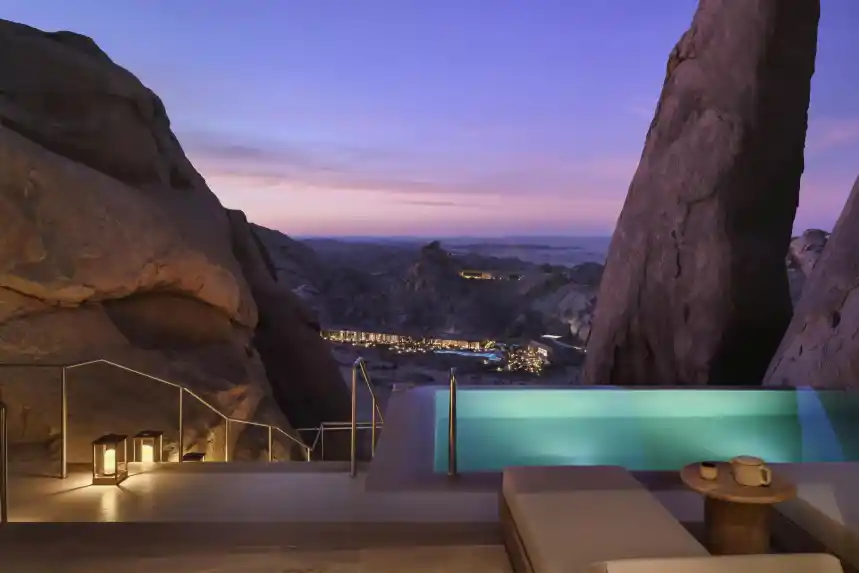
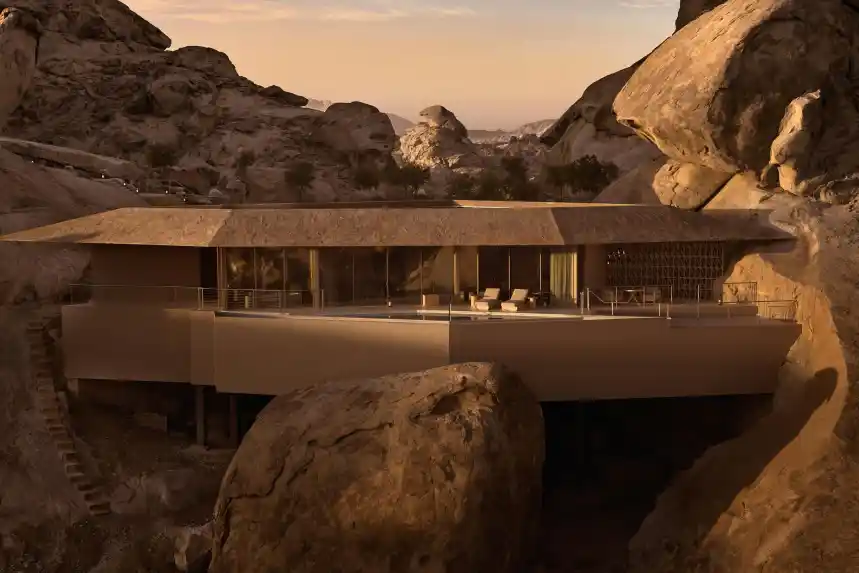
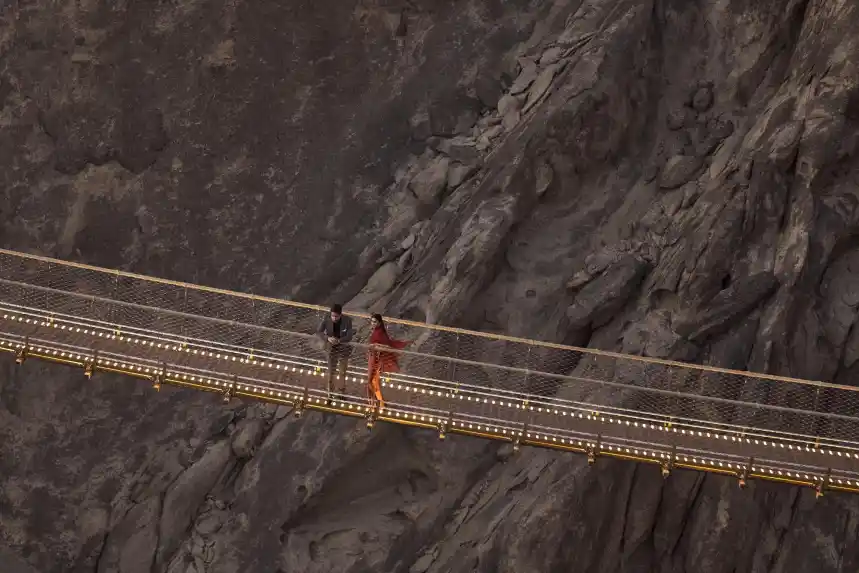
Desert Rock, Hejaz Mountains, Saudi Arabia — Oppenheim Architecture × Red Sea Global. Opened 2025
A variety of residential typologies cater to discerning global tastes. The property features ground-level Wadi Villas complete with expansive courtyards, Cliff-Hanging Villas sculpted directly into the mountainside for sweeping panoramic views, Mountain Crevice Villas suspended between rock pinnacles, and the ultra-private Royal Villas — three-bedroom retreats sequestered deep within a private valley.
Oppenheim Architecture conceived the groundbreaking designs in partnership with developer Red Sea Global. Construction began in 2021, and the collection of 54 villas and 10 suites officially opened to guests in early 2025. Desert Rock is located a convenient 20-minute drive from the Red Sea International Airport.
Desert Rock's 54 villas and 10 suites are secreted within natural caves, rock crevices, and shaded mountain slopes — architecture so perfectly camouflaged it disappears into the ancient sandstone by day, and glows like scattered lanterns by night.
Saudi Arabia and the Question of Authenticity
The most ambitious — and most debated — expressions of this architectural renaissance are taking shape across Saudi Arabia. Under Vision 2030, the kingdom has committed more than $1.3 trillion to real estate and infrastructure. Central to this ambition is the drive to create world-class urban spaces that honor historical roots while embracing futuristic innovation.
Diriyah, a $63 billion giga-project built around a UNESCO World Heritage site near Riyadh, exemplifies this balance. Coined "The City of Earth," the development consists of dense, low-rise blocks featuring traditional mudbrick facades, crenelated parapets, and classic Najdi geometric detailing. The interiors are equally authentic, showcasing woven tamarisk-wood ceilings, carved plasterwork, and hand-dyed regional fabrics.
The visual effect is arresting — a destination that feels simultaneously ancient and newly invented.
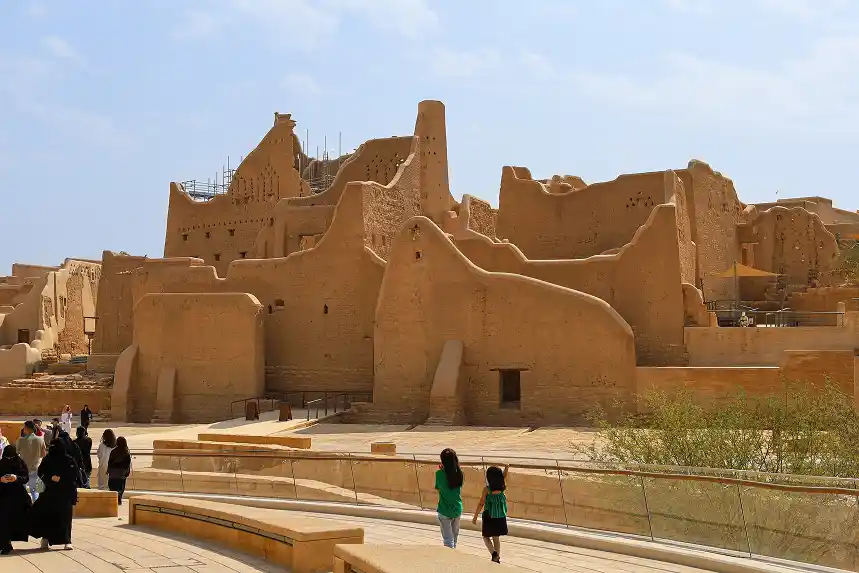
Diriyah, Riyadh — "The City of Earth." A $63 billion giga-project around a UNESCO World Heritage site
The air here carries the distinct, evocative fragrance of sun-baked mud, straw, and native desert clay. At night, as the surrounding wadi palms are irrigated, the atmosphere fills with a deep, earthy petrichor. Geometric star cutouts frame the clear desert sky above, while smooth basalt paving stones line the winding byways below.
Established in 2017, the Diriyah Gate Development Authority is systematically transforming the historical city's neighborhoods to echo classic Najdi architecture. Along with the earthy mudbrick frontage, residents enjoy landscaped internal courtyards lined with geometric mashrabiya screens. The light, airy interiors balance heritage with modernity, featuring state-of-the-art smart home automation and private infinity pools.
This pairing of timeless regional aesthetics with contemporary luxury fulfills the ultimate promise of Desert Modernism: providing a sophisticated shelter that works in harmony with the landscape rather than against it — executed at a scale Palm Springs never imagined.
"This pairing of timeless regional aesthetics with contemporary luxury fulfills the ultimate promise of Desert Modernism — executed at a scale Palm Springs never imagined."